How Does Medication Management Work in Assisted Living? An RN Explains
Medication mistakes are one of the biggest risks of aging at home. Here's exactly how medication management works in assisted living — explained by a nurse.
By Parul Darji, RN, BSN, MSN, MHA
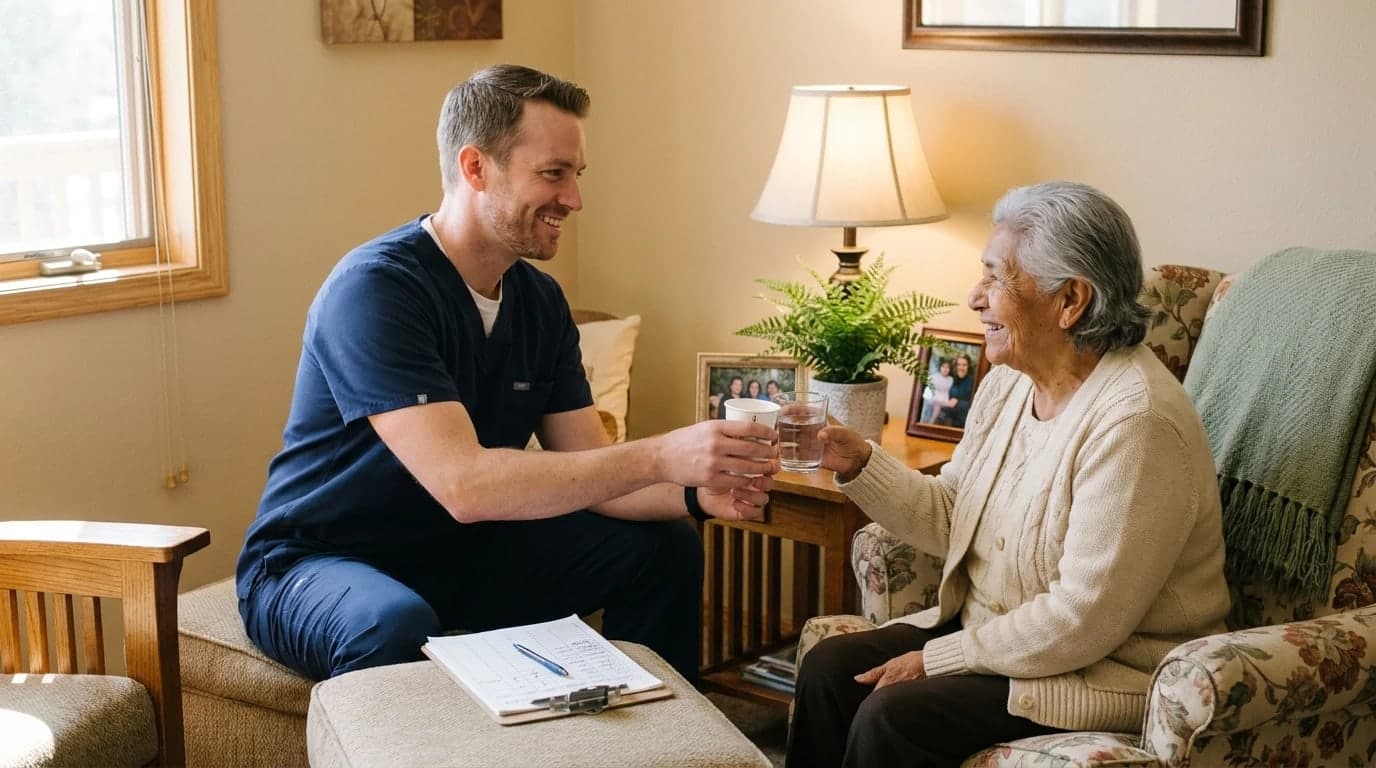
Of all the reasons families finally decide it is time for assisted living, medication is one of the most common — and one of the most important. As a nurse, I have seen how quickly a medication routine can go wrong at home, and how much safer it becomes when there is a system and a trained person behind it. So let me explain, clearly, how medication management actually works in an assisted living community.
Here's what changes the day someone moves in: medications get given by trained, certified staff on a set schedule, every dose is documented, and a nurse oversees the whole process — which lifts one of the biggest and most dangerous burdens of aging alone.
Why is medication such a big risk at home?
Most older adults are not on one or two pills. They are on a handful — sometimes a dozen — each with its own timing, some with food, some without, some that interact. Managing that alone, day after day, is genuinely hard, and the consequences of getting it wrong are serious.
The failures I see most often at home are quiet ones:
- A dose skipped because the day got away from someone
- A dose taken twice because they could not remember the first
- A prescription that changed at a doctor visit but never made it into the daily routine
- Pills that ran out over a weekend and simply were not taken
- Two medications that should never be combined, taken together by accident
None of these look dramatic in the moment. But a missed blood-pressure or blood-thinner dose, or a doubled one, can land a parent in the hospital. Medication safety is, quietly, one of the biggest arguments for a move.
Who actually gives the medications?
In Colorado, this is a regulated role. Medications in assisted living are administered by QMAPs — Qualified Medication Administration Personnel. A QMAP completes a state-approved training program and a competency check before they are allowed to give medications, and they follow established protocols. In our community, that team works under nursing oversight, so there is clinical judgment behind the routine.
That is a meaningful distinction from home, where the "system" is often a parent, a pillbox, and their best memory.
How does the system prevent mistakes?
Good medication management is not one thing — it is a chain, and each link matters:
- An accurate, current medication list. Every medication is reconciled with the resident's physician and pharmacy, so what we give matches what the doctor actually ordered.
- The right dose at the right time. Medications are administered on schedule — including the ones that need to be taken with food, at bedtime, or spaced apart.
- Documentation of every dose. Each administration is recorded. If a dose is refused or held, that is noted too, so there is a real record rather than a guess.
- Communication when something changes. When a prescription is added, stopped, or adjusted, the change flows into the routine and the family is kept informed — no more "the doctor changed something but nobody updated the pillbox."
- A nurse's eyes on the whole picture. Oversight means someone is watching for interactions, side effects, and changes in how a resident is doing.
That structure is exactly what is nearly impossible to hold together alone — and exactly what makes families exhale after a move.
What families notice after the move
The relief is usually fast. Within the first weeks, families tell us the low, constant hum of worry is gone — the "did she take her pills?" question that used to sit behind every phone call. Sometimes we also catch things a busy home routine had missed: a duplicate prescription from two different doctors, or a medication that was quietly doing more harm than good. That is the value of a second set of trained eyes.
Does assisted living replace my parent's doctor?
No — and it's an important distinction to hold onto. Medication management in assisted living is not a hospital, and it does not replace your parent's physician. The doctor still directs the care and writes the orders. What the community adds is the reliable, documented, day-in-day-out execution of that plan — the part that is so easy to drop at home, and where most medication trouble actually begins. Think of it as the difference between having a good prescription and actually taking it correctly, every dose, every day. That stays true as needs change: if a resident later moves to comfort-focused care, the orders change and the same careful routine carries them — something we cover in when a parent enters hospice.
Peace of mind, close to home
For families across Cortez, Dolores, Mancos, and the Durango area, medication safety is often the tipping point — the thing that turns "maybe someday" into "it is time."
Madison House Assisted Living is a small, home-like residence in Cortez, Colorado, where medications are managed by trained, certified staff under nursing oversight. If the pillbox on your parent's counter has become a source of worry, schedule a tour or call us, and I will walk you through exactly how we would care for your loved one's routine.
Frequently asked questions
- Who gives medications in an assisted living community in Colorado?
- In Colorado, medications in assisted living are administered by QMAPs — Qualified Medication Administration Personnel — who complete a state-approved training program and competency check. They work under established protocols, and a nurse oversees the medication process.
- How does assisted living prevent medication errors?
- Through a system: a current medication list reconciled with the doctor and pharmacy, scheduled administration at the right time and dose, documentation of every dose given, and clear communication when a prescription changes. That structure is exactly what's hard to maintain alone at home.
- Can assisted living manage many medications and special instructions?
- Yes. Managing multiple medications with different timings, food requirements, and special instructions is routine in assisted living — and it's often the single biggest safety improvement a family sees after a move. Complex regimens are coordinated with the resident's physician and pharmacy.